
Marketing analytics designed to get you to the truth
Stop making your biggest marketing decisions without precise, trusted data to back them up. We build the measurement solutions that tell you what is actually driving your business, so you can stop guessing and start making decisions with confidence.


The data exists. We show you what it means.
From attribution modeling to custom dashboards, we build the measurement infrastructure that connects marketing efforts to the revenue outcomes you need to track.
Analytics consulting
We evaluate and strengthen marketing measurement infrastructure to improve decision-making, reporting accuracy, and HIPAA-compliant data collection.
COMMON OUTPUTS
Measurement audits, tracking and tagging strategy, HIPAA compliance guidance, reporting frameworks, attribution approach, dashboard planning, analytics implementation roadmaps
Dashboards and reporting
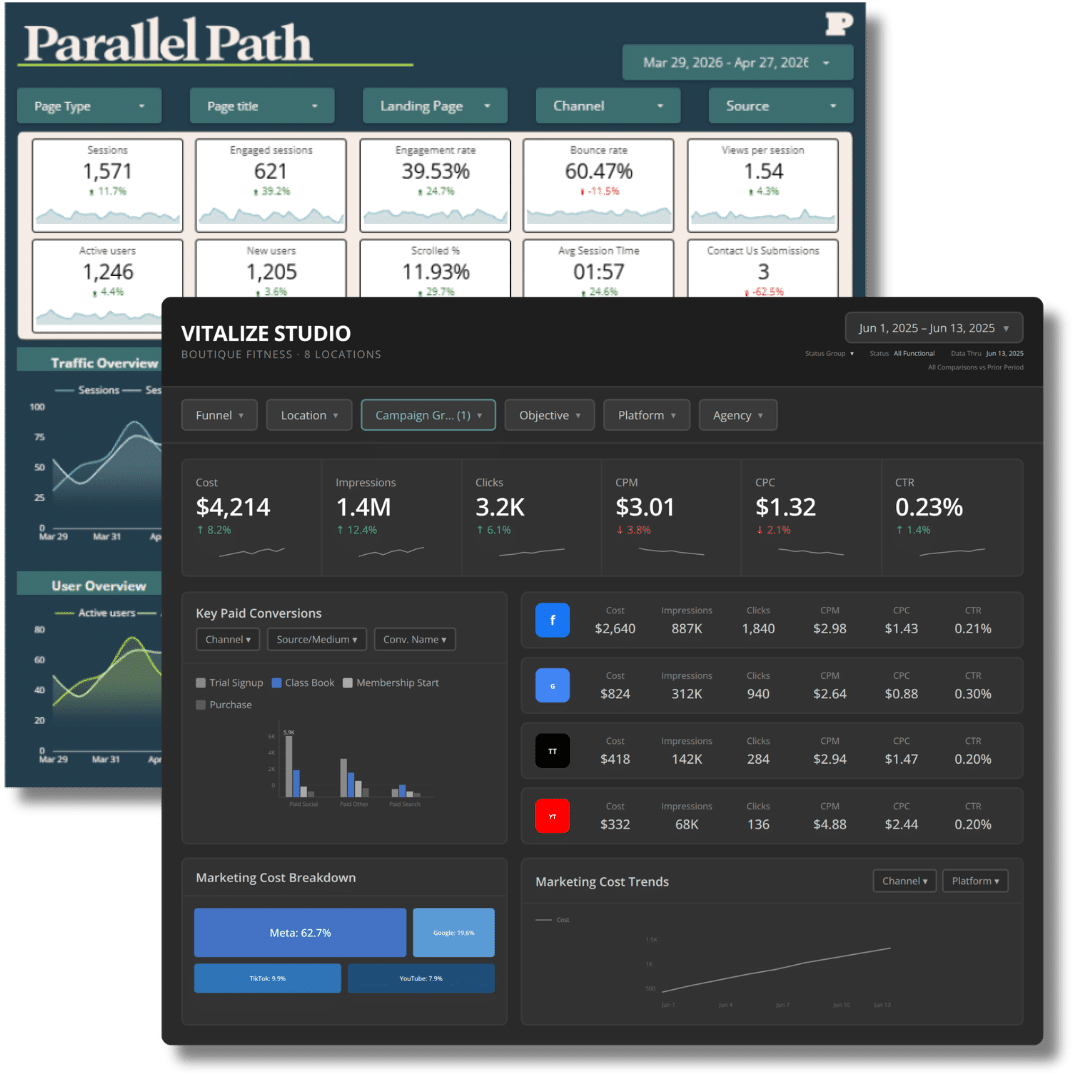
We build marketing reporting infrastructure that centralizes performance data into live dashboards leadership can trust and teams can act on.
COMMON OUTPUTS
Dashboard strategy and planning, reporting infrastructure, cross-platform data integration, KPI and metric frameworks, executive reporting views, visualization and dashboard design, reporting automation
Media mix modeling
We build media mix models that measure how each channel contributes to business outcomes and guide confident budget decisions.
COMMON OUTPUTS
Media mix modeling, channel contribution analysis, budget allocation guidance, forecasting and scenario planning, performance modeling, executive reporting, investment optimization frameworks
Attribution modeling
We build custom attribution models that measure channel contribution more accurately and improve budget allocation decisions.
COMMON OUTPUTS
Custom attribution models, channel contribution analysis, attribution framework design, conversion path analysis, budget allocation guidance, reporting and visualization, performance modeling
Measurement driven performance
Our analytics work has driven performance improvements across a variety of health and wellness categories.

Building a data-driven growth engine for a veterinary hospital network
- 533% ROAS in the first phase of paid search
- 43% increase in hospital visits in first quarter of paid social launch
Parallel Path built the measurement infrastructure that gave MedVet visibility into performance across a growing network of hospitals, creating a scalable data engine that could support new location launches without starting from scratch in every new market.

Increasing patient acquisition for Central Ohio’s largest health system
- 56x greater search engine visibility
- 87% increase in digital-driven conversions
Parallel Path built a measurement infrastructure that treated each hospital and service line as its own trackable entity, creating visibility into what was driving patient acquisition at the market level. The performance gains were real. But they were only visible because the attribution model was built to capture them.

Taking a DTC sports nutrition brand to national retail
- 105% increase in digital marketing revenue
- 9% decrease in spend over the same period
Parallel Path's analytics work identified where Ascent Protein's budget was generating returns and where it was not, enabling a reallocation that drove more revenue on less spend. The efficiency gain was not a media buying decision. It was a measurement decision that made the right media buying decision visible.
Original thinking, research, and tools built for health and wellness marketing.
The Brand Reciprocity Model
Our framework for understanding what drives health and wellness consumers to choose, not just engage. The lens we make every data decision through.
Consumer Motivation Study
Independent research designed to understand the motivations shaping consumer decisions across health and wellness.
SideCountry AI Studio
Our AI-supported strategy and execution studio for analysis, content planning, campaign development, and efficient activation.
Your data isn't the problem. Your confidence in it is.
In health and wellness, measurement infrastructure is rarely built around the questions leadership asks. It is built around what the platforms can report. What your data shows and what you can stand behind in a room are rarely the same thing.
The signs are recognizable:
- Reports get produced but decisions still feel like guesses
- Channel metrics look fine but nobody can explain the full picture
- Leadership asks questions the data technically answers but nobody fully trusts
Accurate measurement is not a tool problem. It is an infrastructure decision that has to be made correctly from the start.

Analytics consulting
Are my marketing analytics telling me where I should actually be investing?
How do I tell the difference between underperformance and undermeasurement?
How do I know if my measurement setup is HIPAA compliant?
Bad data does not announce itself. It quietly shapes decisions: which channels get budget, which campaigns get cut, and which markets appear to be underperforming when they are actually being undermeasured. Analytics consulting examines where tracking is breaking down, what your measurement setup can and cannot tell you, and where gaps in your data are distorting business decisions.
For healthcare organizations, that also means ensuring measurement infrastructure is built in compliance with HIPAA requirements governing how patient and consumer data is collected and used. The outcome is a measurement foundation your organization can confidently build strategy, reporting, and investment decisions on.

Dashboards and reporting
What is the best way to aggregate and visualize marketing performance data?
How do I give leadership access to marketing performance data in real time?
What metrics should be included in a marketing dashboard?
Your marketing data already exists. It is just spread across multiple platforms, disconnected from the metrics leadership actually cares about, and manually pulled together when someone asks for a report. By the time it gets presented, it is already outdated.
We build reporting infrastructure that pulls your marketing data into a single live view configured around the metrics that matter to your business. The result is reporting your team can use day-to-day and leadership can trust when decisions need to get made.


Data and analytics built for the complexity of health and wellness.
We built our analytics practice from the inside out specifically for today’s health and wellness brands. The attribution gaps, multi-location reporting complexity and, for some, the HIPAA constraints are not edge cases we design around. They are foundational to all that we do.
This experience allows us to quickly assess, design and build an analytics infrastructure that connects every marketing activity to the outcomes you seek, built correctly from the start.
Health & Wellness Industries Served
Fitness & Recovery
Nutrition, Vitamins & Supplements
Specialty Clinical
Sleep & Recovery
Pet Health & Wellness
Women’s Health
Hospitals & Health Systems
Mental Wellness
Consumer Health Technology
Healthy Dining
Personal Care & Beauty
Functional Health
Longevity & Preventative Wellness
Wellness Tourism
- and more…
Media mix modeling
How do I measure the impact each channel has on conversions?
Is it possible to tie channel performance to business outcomes?
What marketing performance models do CFOs trust most?
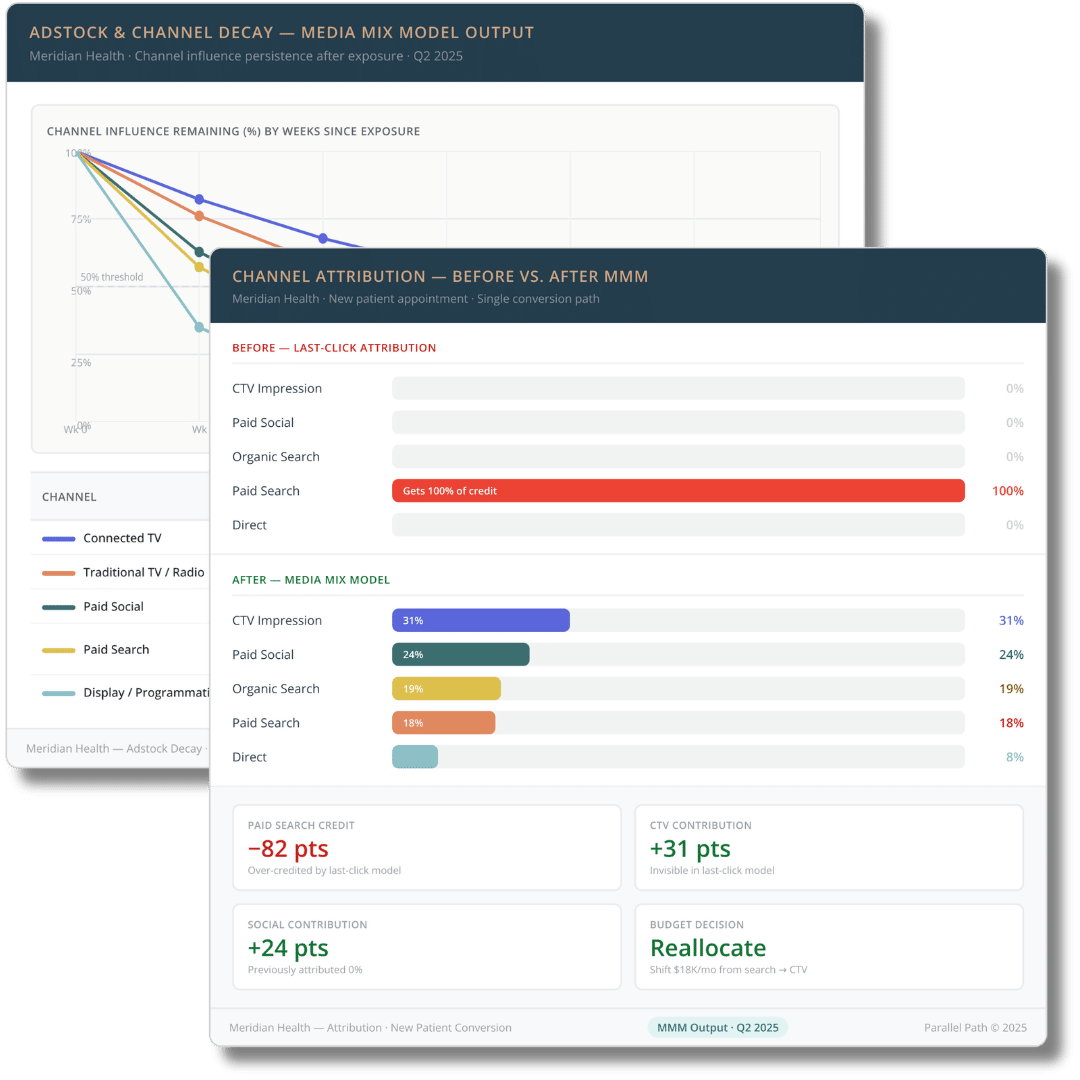
Does your reporting only explain part of your marketing performance? Media mix modeling helps give brands a complete picture of how every channel contributes to revenue, not just the channel metrics that are easiest to track.
Using statistical analysis tied to actual business outcomes, we isolate the contribution of each channel across your marketing program so budget decisions are based on evidence rather than assumption. The result is reporting leadership can use to confidently evaluate where additional investment will create the greatest impact.
Attribution modeling
Why do the channels that are easiest to track always get the most budget?
Should my attribution model be customized to my business?
How do you build marketing attribution models in healthcare?
Most attribution models over-credit the channels that are easiest to track, not necessarily the ones driving decisions. In health and wellness, where journeys are longer, more research-heavy, and shaped by more touchpoints, that gap distorts every budget decision that follows.
We build custom attribution models that reflect how decisions are actually made, giving you clearer visibility into which channels are earning their budget. For healthcare organizations, where consideration cycles are longer and data constraints are stricter, attribution is harder to get right. We build models designed around those realities so budget decisions are based on the clearest picture possible.

Is your brand building consumer relationships?
The Brand Reciprocity assessment scores your brand across three connectors: Shared Identity, Curated Experiences, and Intentional Connections. It tells you which stage you’re in and what to fix first.
12 questions. A specific score, a personalized diagnostic, and a prioritized action plan. No pitch.


common questions
Measurement questions from health and wellness marketers
Healthcare analytics consulting is the work of building, auditing, and optimizing the measurement infrastructure that tells a health and wellness organization what its marketing is actually driving and where it is breaking down. In practice that means assessing how data is currently being collected and where it is breaking down, defining the conversion events that matter to your specific business, selecting and configuring the right attribution model for your patient and consumer purchase journey, and building the reporting architecture that connects channel activity to the outcomes your organization can act on.
It also means ensuring that every element of that infrastructure is built in compliance with HIPAA, so that the measurement setup that improves your marketing performance does not create a data handling liability in the process. For healthcare organizations operating across multiple locations or service lines, consulting also includes aligning reporting across markets so that performance comparisons are based on consistent data rather than inconsistent tracking configurations.
Multi-touch attribution and media mix modeling answer different questions and are built from different data. Multi-touch attribution tracks individual consumer journeys across digital touchpoints, assigning credit to the specific channels and interactions that contributed to a conversion. It is precise at the individual level but limited to the channels you can track directly.
Media mix modeling takes a broader view, using statistical analysis of aggregate data across all channels, including traditional media like television and radio that cannot be tracked at the individual level, to estimate the contribution of each channel to overall business outcomes. For health and wellness brands running integrated programs across both digital and traditional channels, the two approaches are most powerful when used together.
Multi-touch attribution informs day-to-day optimization. Media mix modeling informs how budget gets allocated across the full program.
The most common reason leadership loses confidence in marketing reporting is that the metrics being reported do not connect clearly to the business outcomes leadership tracks. Impressions, clicks, and cost per lead are media metrics. They describe channel activity. They do not, on their own, explain whether marketing is driving appointments, memberships, patient visits, or revenue.
Building a measurement infrastructure leadership trusts starts with agreeing on the business outcomes that matter before any tracking is configured, then building the attribution model and reporting architecture backward from those outcomes. It also requires honesty about what the data can and cannot tell you, including where multi-location complexity, long consideration cycles, or channel mix creates gaps that need to be designed around rather than ignored.
A measurement framework that overpromises and underdelivers is worse than one that is honest about its limits.
A marketing analytics dashboard for a multi-location brand needs to work at two levels simultaneously. At the enterprise level it should show aggregate performance across all locations, total spend, overall return, and trend lines that help leadership evaluate the program as a whole. At the location level it should surface the performance of individual markets clearly enough that the teams responsible for those locations can make fast decisions without waiting for a monthly report.
The data feeding both views needs to come from a single, consistent measurement infrastructure, otherwise what looks like a performance difference between locations is often just a data discrepancy. For health and wellness brands specifically, dashboards should surface the metrics most relevant to their category rather than defaulting to generic digital marketing metrics that do not map to how the business actually measures success.
That might mean patient acquisition costs for a health system, membership conversion rates for a fitness brand, appointment volume for a veterinary network, or revenue per SKU for a DTC nutrition company.
Marketing attribution in healthcare works the same way it does in any other category at the technical level. Touchpoints are tracked, conversion events are defined, and credit is assigned across the consumer journey based on the model you select. What makes healthcare attribution distinct is the complexity of what you are trying to measure and the constraints you are operating within.
Healthcare purchase journeys are longer and involve more research touchpoints than most other categories, which means last-click attribution consistently misrepresents what is actually driving conversions. The consumer who books an appointment after clicking a paid search ad has usually visited the website multiple times, read reviews, and engaged with content across several channels before that final click. Building an attribution model that accounts for that journey requires both the right technical setup and an understanding of how health and wellness consumers actually decide.
HIPAA compliance adds another constraint, governing how patient and consumer data can be collected, stored, and used throughout the attribution process.
A marketing analytics audit examines whether your current measurement setup is telling you the truth. That means looking at how tracking is configured across every channel, whether conversion events are defined correctly and firing consistently, where attribution is breaking down or assigning credit inaccurately, and whether the data flowing into your reporting tools is clean enough to make decisions from.
It also looks at what your current reporting cannot tell you, the gaps between the data you have and the questions your organization actually needs to answer. For most health and wellness brands, an audit surfaces two or three significant issues that have been quietly distorting reporting for months or longer, along with a clear picture of what it would take to fix them.
The audit is not a deliverable. It is the foundation everything that gets built afterward is built on.
Tools surface data. They do not tell you whether the data is right, whether you are measuring the right things, or whether the decisions you are making from it are sound. A junior associate configuring GA4 or building a Power BI report is working with the tools available to them, but if the underlying measurement architecture is broken, the tools just make the wrong numbers easier to see.
Analytics consulting is not about the tools. It is about whether the infrastructure feeding those tools is built correctly, whether the right conversion events are defined, and whether what comes out the other end actually connects to the business outcomes leadership tracks. For health and wellness brands, that also means navigating the complexity of multi-location attribution, long consideration cycles, and channel mix in ways that are genuinely hard to see from inside the organization.
The right tools in the right hands with the right architecture underneath them is what accurate reporting actually requires. The first two are rarely the problem. The consulting work closes the gap on the third.

Take The First Step
Guidance for good.
At Parallel Path, we combine the thoughtfulness of a consultancy with the agility and execution power of a marketing agency.
Together, we’ll craft the strategy and content you and your brand need to tell your story and succeed.